From Intertitles to Dialogue: How Silent Films Made Words Visible
Learn how silent film intertitles carried speech, clarified plot, and shaped rhythm—and how gestures, objects, and editing made words visible on screen.
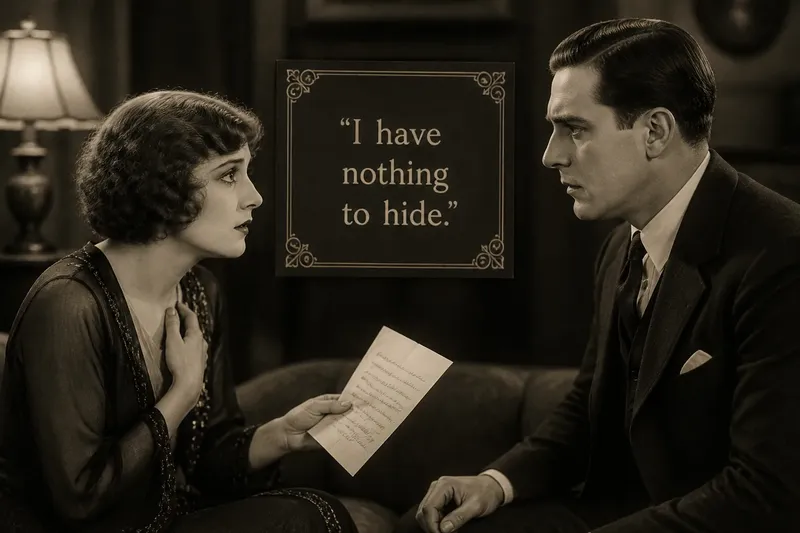
A silent-film intertitle can interrupt a close-up, announce a line of dialogue, then vanish before the actor answers with a glance. To understand how silent films made words visible, watch the card as part of the scene’s action, not as a substitute for sound. Its wording, placement, and timing could direct attention, shape a character, or change how the next image was read.
Silent films had several ways to put words on screen
“Silent” describes the absence of synchronized recorded dialogue in the projected film; it does not mean that every screening was literally quiet. Live musicians, narrators, or other accompaniment could contribute to a performance, depending on the venue and practice. On the strip of film itself, however, filmmakers had to make spoken exchanges legible without recording the voices.
The familiar intertitle is a separate card inserted between moving images. A dialogue title presents a character’s words, often with a name or visual cue that tells viewers who is speaking. An expository title supplies information such as a location, a passage of time, or a fact the image alone might not make clear. These roles could overlap: a card might sound like speech while also explaining a relationship or setting up a plot turn.
Not every word had to appear on a card. A letter, sign, newspaper headline, or label could carry information within the photographed scene. A character might point to a written message, read it, and react. The viewer sees both the text and its effect, so the words become an object in the action rather than a pause outside it.
A title card changes the image that comes after it
Intertitles work through sequence. A card gives the viewer a piece of language; the following image supplies a face, gesture, or event that can confirm, complicate, or contradict it. Remove the image after the card and the line loses its performance. Remove the card and the image may become harder to interpret. Meaning is produced by their relation.
Consider a character who says, “I have nothing to hide,” followed by a shot of that character concealing a letter. The card gives the spoken claim; the image exposes the mismatch. In another scene, a title such as “At last, we are alone” might turn a quiet two-shot into a romantic confession, while a suspicious look could make the same line feel strategic. The wording narrows the possibilities, but the actor’s behavior keeps the scene alive.
That exchange makes an intertitle more than a caption. It can act like a cut in the conversation: the film leaves a face, presents a line, then returns to a response. A title card may even hold a beat longer than a spoken line would, leaving the audience time to absorb a joke, worry about a threat, or notice a reaction before the next image.
Actors and objects carried the parts the cards left out
A title can tell viewers what a character says, but it cannot supply every quality of a voice. It cannot, by itself, show hesitation, warmth, sarcasm, or an attempt to sound calm. Silent-film performers made those qualities visible through facial expression, posture, gesture, and the pace of movement. A hand that reaches and stops can make a line feel reluctant; a quick turn toward the door can suggest that a character is listening for someone outside the frame.
Props could carry a conversation’s stakes. A telegram, photograph, invitation, or torn note gives characters something to read, hide, exchange, or destroy. The audience can follow the object’s passage and watch each person respond. Even when the card states the message, the prop grounds it in the story’s physical world.
These visual cues need not translate every word. A filmmaker might show a person receiving an insult, then use the recipient’s stiff smile and retreating step to make the social injury plain. The card provides the line; the body shows its cost. That division keeps a scene from becoming a stack of written exchanges.
Editing made written speech feel like conversation
The order of shots helps a viewer assign a line to a speaker. A card placed after one person looks toward someone offscreen may be read as that person’s words. A cut to the listener afterward creates a response, even if the response is a pause rather than another title. Alternating images of the speakers can build a conversational rhythm through looks and gestures.
Editors also had to decide when to insert a card and how long the surrounding images should hold. A card arriving too early can explain what the audience has already understood. One arriving after a crucial gesture may leave viewers unsure what prompted it. The best placement depends on what the scene wants the audience to notice first: the information, the speaker, or the reaction.
Comedy makes this timing especially visible. A title can deliver a boast, then cut to a small failure that punctures it. A pause before the reveal can build expectation; a rapid change from card to image can make the contradiction land sharply. In a tense scene, a delayed title may let a look or an approaching figure carry the suspense before the words identify the danger.
What should you look for in an intertitle sequence?
How can I tell dialogue titles from explanatory titles?
Look for whether the wording sounds like something a character would say, and whether the surrounding shots show a speaker or listener. A card that supplies a place, time, or background fact without a visible conversational exchange is more likely to be explanatory.
Why do some cards show text inside the scene?
A letter or sign belongs to the photographed world, so a character can handle it and react to it. That lets the film show both the information and the moment it changes someone’s behavior.
What does a reaction shot add after a title?
It shows how the line lands, which may differ from what the speaker intended. A silent response can signal affection, suspicion, embarrassment, or refusal without adding another sentence to the exchange.
Why might a card repeat information that the image seems to show?
The image may establish an action while the title clarifies its meaning or the character’s intention. Repetition can also steer viewers away from one interpretation and toward the story’s intended reading.
Read the card and the image as one piece of storytelling
Try tracking a short exchange without reading the title cards first. Notice who looks toward whom, which person moves, and what changes in the listener’s face or posture. Then read the cards and watch again. The comparison reveals what the writing contributes and what the performance already communicates.
Say you are watching an invented scene in which a shopkeeper slides a sealed envelope across a counter. The card reads, “No one can know you came here.” The customer hides the envelope instead of opening it, then checks the doorway. The words establish a secret, while the object, concealment, and glance show how the customer responds. If the customer smiles and leaves the envelope in plain sight instead, the same sentence might feel like a warning the character does not believe.
When you watch silent cinema, treat each card as a choice about attention. Ask what it tells you, what the actor adds, and why the film places it between those particular images. That approach makes silent-film intertitles easier to read, and it also reveals how much of the scene’s speech was already being carried by faces, props, and cuts.