The Frame Within the Frame: Why Doorways Hold Our Attention
Learn how a doorway or window inside the frame directs attention, separates characters, and gains meaning from the scene around it without feeling forced.
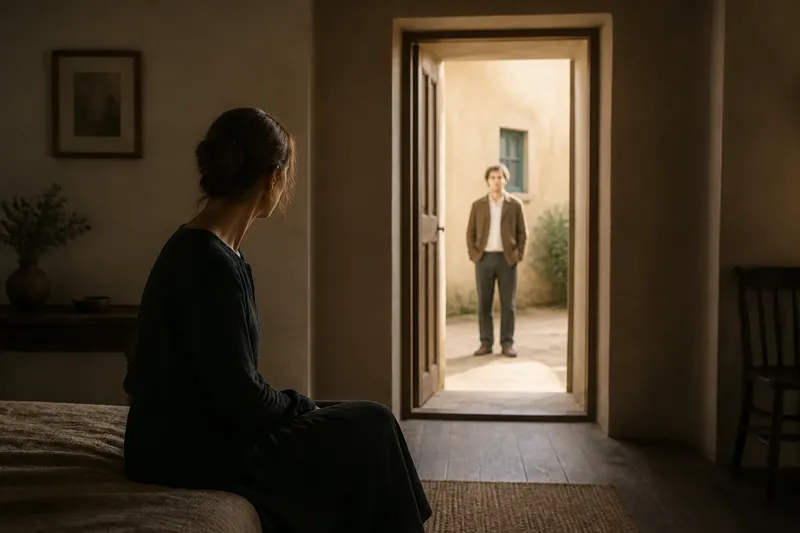
Why does a character framed by a doorway draw your eye before another person standing in the open room? In film composition, a frame within the frame—often a doorway or window—gives the image an inner boundary that can organize space and direct attention. When it feels awkward, the cause is usually not the opening itself but how it relates to the characters, camera, and scene.
Start with the attention problem, not the doorway
A doorway attracts attention through contrast and enclosure. Its edges make a visible shape, and the area inside it can isolate a face or body from the room beyond. That effect is useful when the audience needs to notice who has arrived, who is being watched, or who is kept apart.
But the opening does not carry a fixed meaning. A character in a doorway might seem welcome, trapped, secretive, or simply in transit. The surrounding action supplies the context: who controls the room, what happened just before, and whether the character chooses to enter or remains outside.
Before composing the shot, name the intended point of attention in plain terms. Is the audience meant to watch a person cross the threshold, see someone waiting beyond it, or register the distance between two characters? If the answer is unclear, adding a strong rectangular shape may make the shot busier without making it more legible.
The doorway competes with the subject
A common problem is that the opening becomes more noticeable than the person inside it. A bright window, a high-contrast corridor, or several nested doorframes can pull the eye toward the background. The subject may be technically framed but still feel secondary.
Usually, the competing area has more visual contrast, more detail, or a more striking shape than the subject. Look at the still image at its intended size, not only on a large monitor. Notice where your eye lands first and what it visits next.
- Reduce background contrast. If practical, adjust the visible area beyond the doorway or use lighting that keeps it from overpowering the face.
- Simplify the opening. Reposition the camera to remove extra doorframes, bright wall edges, or clutter that creates a second focal point.
- Give the subject a clearer separation. A different position, silhouette, or value against the background can help the person read without adding decoration.
- Use movement deliberately. If the character should command attention, let their entrance or turn provide a clear change in the image.
Imagine a scene in which a character waits in a dim room while a sunlit hallway fills the doorway behind them. If the hallway is meant to suggest an approaching visitor, keep the waiting character readable but allow the brighter opening to pull attention briefly; then have a figure enter and shift the focus. If the waiting character is the scene’s main concern, reduce the hallway’s visual dominance so the face holds attention instead.
The frame feels like a box around the actor
A doorway can make a composition feel static when the person is centered, motionless, and held inside a rigid rectangle for too long. The audience may read the opening as a border with no reason to be there. This often happens when the composition is designed as a still image but the scene depends on changing relationships.
Give the boundary a job over time. A character can approach it, pause at its edge, retreat, or cross while another person stays behind. The movement changes the meaning of the same space: entering can suggest access, while stopping short can make a threshold feel like a decision.
If the scene is quiet, small shifts can be enough. Let one character occupy the opening while another remains in the foreground, or allow the door to move through the shot if that action belongs in the scene. Avoid movement added only to animate the frame; it should reveal a choice, alter who can see whom, or change the distance between people.
The opening separates characters without explaining why
Two people placed on opposite sides of a doorway may look separated, but the image needs support before viewers can tell what that separation means. It might signal an argument, a difference in status, a private space, or a temporary pause. If their positions do not connect to the action, the frame can imply a relationship the scene has not established.
Check the characters’ eyelines, body angles, and access to the opening. A person who faces into the room may appear ready to join; someone turned away may seem to reject contact. The doorway can also regulate visibility: one character sees the other, while the audience sees only part of the person beyond the threshold.
Use this arrangement when separation is already part of the scene’s situation. If the characters are meant to feel close, let them share the same visual space or cross the threshold. If the gap matters, keep it visible and make their behavior respond to it.
The composition looks meaningful but the scene says otherwise
A strong doorway image can tempt a filmmaker to assign it a symbolic meaning before the scene supports one. A threshold may suggest a choice, but it does not automatically represent transformation or danger. Viewers interpret the shape through the character’s behavior and the events around it.
Ask what changes if the doorway is removed from the composition. If the scene loses useful information—such as who is outside, who has permission to enter, or who is watching—then the inner frame is doing narrative work. If nothing changes except the image’s neatness, consider a simpler composition.
Match the framing to the scene’s tone, too. A sharply centered doorway can feel formal or controlled; an off-center opening may leave more room for uncertainty or activity elsewhere. Those are possible effects, not fixed rules. The performance, camera position, lighting, and surrounding space all affect the reading.
How should you troubleshoot a frame within the frame?
Should the character be centered in the doorway?
Centering can make the figure feel held, exposed, or deliberately presented, but it may also look stiff. Try an off-center position when the character needs room to move, look, or relate to someone elsewhere in the shot.
Does a window work like a doorway?
Both create an inner boundary, but a window often emphasizes viewing, distance, or limited access because characters do not usually pass through it. Choose the opening whose physical use fits the scene rather than treating the two shapes as interchangeable.
How can you tell whether the opening is distracting?
Pause on the shot and look away for a moment before viewing it again. If your attention lands on a bright or detailed patch beyond the subject, simplify that patch or adjust the subject’s placement so the intended focal point reads more clearly.
Should the camera move through the doorway?
Move through it when crossing the boundary changes what the audience knows or whose space the shot occupies. If the move adds no new point of view or action, a stable camera may make the relationship easier to read.
Let the threshold change meaning with the scene
When reviewing a doorway composition, check the first point of attention, the subject’s separation from the background, the characters’ access to one another, and whether the boundary changes during the action. Make one adjustment at a time so you can see which visual relationship improves.
The frame within the frame works best when it helps the audience read a specific relationship, not when it merely decorates the image. Keep the opening only if it clarifies who is entering, watching, waiting, or being kept apart. In a later shot, the same doorway can carry a different meaning because the character’s choices have changed.